If You and Your Spouse Die Days Apart, Who Inherits First?
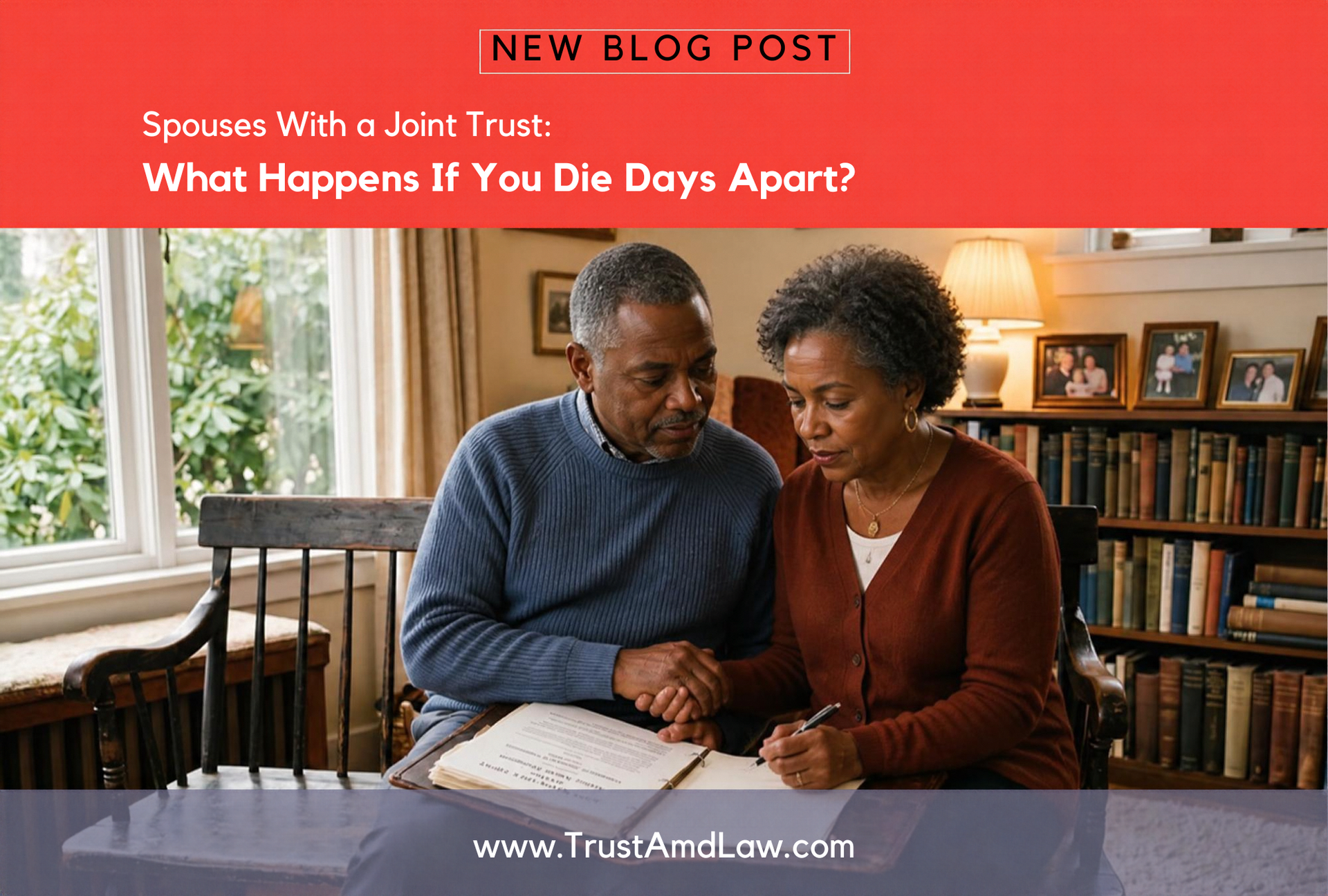
You and your spouse planned for one of you to carry on. You named each other as beneficiaries and talked about how the survivor would care for your family.
It is understandable if you never asked what happens when neither of you can.
What happens if spouses die at the same time, or only days apart? When I review your plan, I want you to be able to answer three questions:
- Who inherits first?
- How long must that person survive you?
- Who inherits if they do not?
You may remember the deaths of actor Gene Hackman and his wife, Betsy Arakawa, in 2025. Authorities concluded that she died before he did, with their deaths occurring days apart. Their story is a heartbreaking reminder that spouses do not always have years between their deaths to revisit a plan. (Source: Associated Press)
For your family, that raises a practical question: If you leave everything to each other, what happens when neither of you is there to carry on? Surviving a spouse by a few hours does not always mean inheriting. Your documents, the rules for each asset, and state law determine what happens next.
When I create a Life & Legacy Plan with you, we answer those questions while you can choose the outcome together. I connect the legal instructions with your assets and the people you want to protect.
What Happens If Spouses Die at the Same Time? Your Plan and State Law Decide
If you leave most of your assets to your spouse, you probably picture them using the money for years. But suppose your spouse dies just two days after you. Who receives that property next?
Imagine your will leaves property to your spouse, whose will leaves their estate to children from a prior marriage. For property passing under your will, the question is whether your spouse lived long enough to meet the required survival period. If so, that property may pass into their estate and then to their children. If not, your documents and state law determine who receives it instead.
Probate is the court-supervised process for administering an estate. Property that goes through probate at both deaths may need to be administered twice. But two deaths do not automatically mean two probates: assets held in trust or passing directly to a named beneficiary follow their own rules.
In a blended family, where one or both spouses have children from a previous relationship, you may want to support your spouse while preserving your children’s inheritance. Your plan needs to address both wishes, including what happens if you die days apart.
The bottom line: When two deaths happen close together, a difference of hours can change which document controls and who ultimately inherits.
What a Survivorship Clause Actually Does
A survivorship clause says how long someone must live after you to receive an inheritance. Your plan might require your spouse to survive you by 30 days, for example. The right period depends on your goals, the rest of your plan, and state law.
If the person does not survive for that period, the clause treats them as having died before you for that inheritance. The plan’s backup instructions, together with applicable law, determine who receives those assets instead.
In our two-day example, a valid 30-day requirement would keep the inheritance governed by that clause from passing to the spouse. Naming the backup recipients matters just as much as choosing the number of days.
But a clause in your will does not automatically change your life insurance, retirement account, or property deed. Each asset needs to be checked against the instructions and rules that apply to it.
The bottom line: A survivorship clause can prevent an unnecessary second transfer, but it must work with the assets it is meant to govern.
The 120-Hour Rule Is a Default, Not Your Family’s Plan
What if your documents do not spell out a survival period? State law may supply one. The Uniform Simultaneous Death Act uses 120 hours, or five days, as a default. In states following that approach, someone generally must survive you by that period to inherit, unless the governing document or applicable law provides otherwise.
That means living two days longer may not be enough. But the five-day rule does not apply everywhere or in every situation, and your documents may set a different period.
A default rule cannot know whether you want property kept in one side of the family, whether a beneficiary has special needs, or how you want to provide for children from a previous relationship.
That is why I ask about your family before recommending the wording. A longer survival period is not automatically better. The instructions need to fit your wishes and the law that applies.
The bottom line: State law can supply a backup rule. It cannot choose the outcome that reflects your family’s values.
A Joint Trust Does Not Make the Question Disappear
Couples with a joint revocable trust sometimes assume the trust answers every close-in-time death question automatically.
It may not.
The trust still needs to explain what happens at the first death, what changes if the surviving spouse dies during the stated survival period, and how the remaining assets divide after both spouses are gone. Separate property, retirement accounts, insurance proceeds, and assets never transferred into the trust can raise additional questions.
For a blended family, the plan needs to support your spouse and preserve what you intend for your children. That may mean setting aside separate shares, keeping some assets in trust after your death, or giving different instructions for particular property.
There is no one-size-fits-all clause I can paste into every couple’s plan. The language has to match the ownership of your assets, your family relationships, your tax picture, and what you want to happen next.
The bottom line: A joint trust is a tool. It works only when its instructions match your assets and the family outcome you intend.
Beneficiary Forms Need the Same Answer
Your will and trust are not the only instructions that matter. Life insurance, retirement accounts, and certain bank or investment accounts generally pass to the recipients named on their beneficiary forms. Those forms need to work with your broader plan.
Consider a life insurance policy naming your spouse first and an adult child as the backup. If your spouse dies shortly after you, who receives the benefit? The policy, beneficiary form, and state law determine the answer, not simply what your will says.
During a planning review, I compare those forms with the trust, will, asset ownership, family structure, and the roles each person is meant to play. I also coordinate with your financial, insurance, and tax professionals when their expertise is needed.
That is what it means to hold the whole picture. Your family does not experience the trust, retirement account, insurance policy, and house as separate planning projects. When something happens, all of them arrive at once.
The bottom line: Your survivorship instructions are only as strong as the coordination among your legal documents, asset titles, and beneficiary forms.
Your Family Needs an Answer Before the Emergency
When deaths happen close together, your family will not have the time or emotional capacity to reconstruct what you meant.
Because you have an ongoing Personal Family Lawyer® relationship, your family has someone who already knows your plan, your people, and what your wealth was meant to do. I can help them identify which assets are involved, which instructions control, and which other advisors need to be brought in.
That relationship begins before the crisis. We clarify the plan, keep it aligned as your family and assets change, and make sure the people you love know who to call.
Together, we answer four questions:
- If we die hours or days apart, whose beneficiaries receive the assets?
- Would any property pass through two estates or probate proceedings?
- Do our trust, will, asset titles, and beneficiary forms give the same answer?
- Does that answer still fit our family today?
It also matters in the moment. While your family gathers for the funeral, I can help the person administering your plan identify the documents and advisors needed for the next decisions.
The bottom line: Clear documents answer the legal question. An ongoing relationship helps your family carry out the answer when it matters.
Life & Legacy Planning® Session: What You Can Do Right Now
Look for “survive” or “survivorship” in your documents and note the survival period for our review. Do not change a beneficiary form or copy a survivorship clause from the internet based on this article. State law and document language matter, and the right answer depends on your family. As your Personal Family Lawyer firm, I don’t use one-size-fits-all planning. Your Life & Legacy Plan should reflect your family, assets, and values.
The relationship doesn’t end when the documents are signed. When something happens, your family knows to call me.
Schedule a complimentary 15-minute discovery call to review how your plan handles deaths close together:
calendar.trustamdlaw.com/widget/booking/JDAbqicl45eEE3dRRmpb
This article is a service of AMD LAW, a Personal Family Lawyer Firm. We don’t just draft documents; we ensure you make informed and empowered decisions about life and death, for yourself and the people you love. That's why we offer a Life & Legacy PlanningⓇ Session, during which you will get more financially organized than you’ve ever been before and make all the best choices for the people you love. You can begin by calling our office today to schedule a Life & Legacy Planning Session.
The content is sourced from Personal Family Lawyer® for use by Personal Family Lawyer firms, a source believed to be providing accurate information. This material was created for educational and informational purposes only and is not intended as ERISA, tax, legal, or investment advice. If you are seeking legal advice specific to your needs, such advice services must be obtained on your own, separate from this educational material.
© 2026